
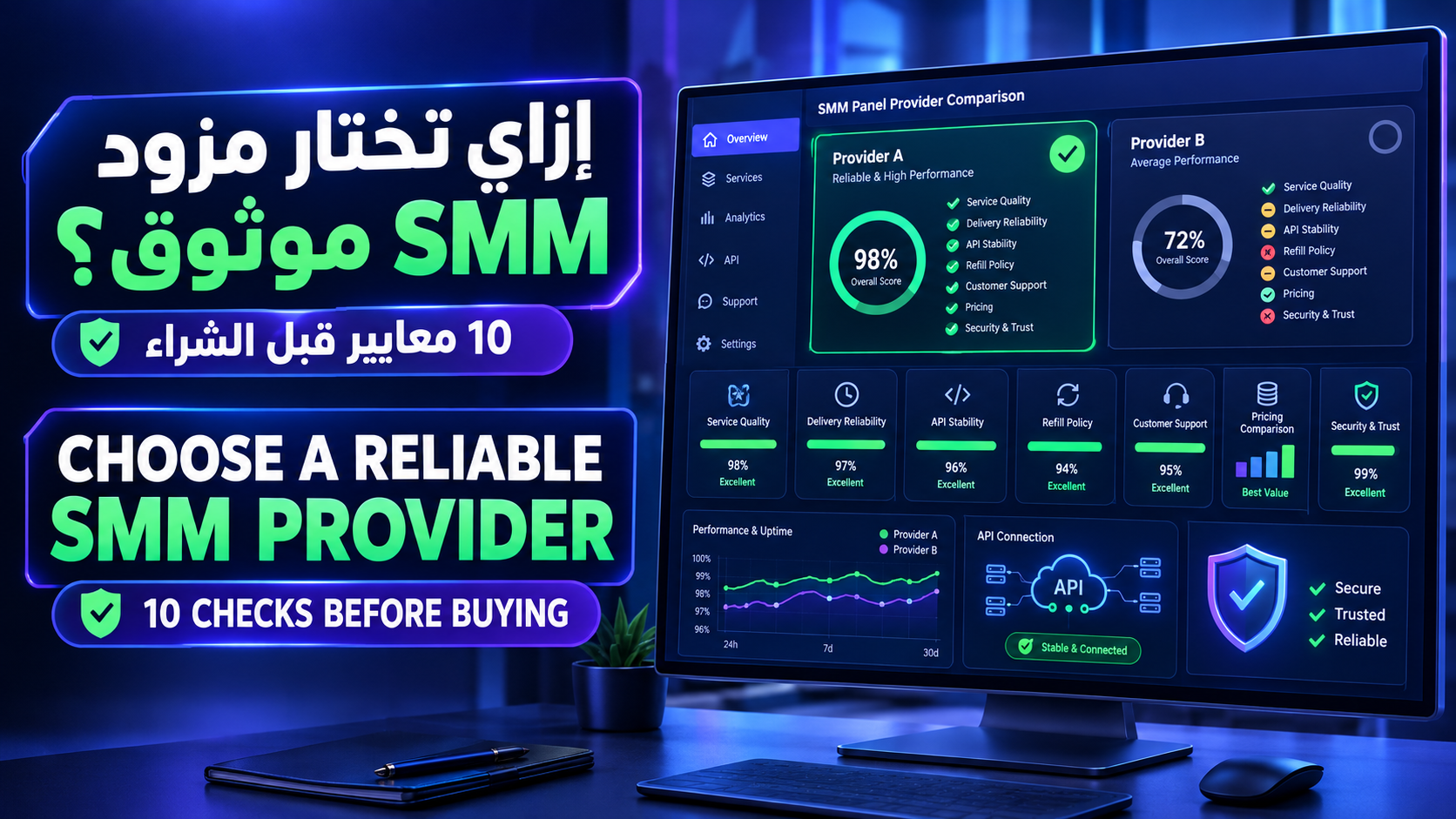
How to Choose a Reliable SMM Panel Provider: 10 Checks Before Buying
Choosing an SMM Panel provider is not just about finding the lowest price. A service may look affordable at first, but delayed orders, incomplete delivery, unclear refill policies, or poor technical support can quickly increase your operating costs.
If you manage an SMM panel, resell social media services, or need a dependable supplier for order fulfillment, you need to evaluate more than the advertised rate.
This guide explains 10 practical checks you can use to assess an SMM provider, test its services, and reduce avoidable risks before committing a larger budget.
What Is an SMM Panel Provider?
An SMM Panel provider is a supplier that offers social media-related services, such as followers, views, likes, and other engagement services, to customers or reseller platforms.
Some SMM panels provide services directly, while others connect to external suppliers through an API. In a reseller setup, the provider acts as an upstream supplier, while the panel handles the storefront, pricing, and customer orders.
Your provider can affect delivery performance, operating costs, customer satisfaction, and your ability to manage orders efficiently.
The key point is simple: the cheapest provider is not necessarily the best provider, and one successful order does not prove long-term reliability.
1. Check the Service Description Before Comparing Prices
Start by reviewing the details of the service you intend to buy.
A useful service description should explain what the service does and what the buyer needs to know before placing an order. Vague claims such as “premium quality” or “instant delivery” are not enough.
Check the following details:
Supported platform and service type.
Minimum and maximum order quantities.
Expected start time and delivery estimates.
Accepted link formats and target-account requirements.
Whether the service supports refills.
Whether cancellation is available and under what conditions.
What happens when an order fails or completes partially.
If important information is missing, ask the provider before depositing funds. If the answers remain vague, treat that as a reason to investigate further.
2. Test Service Quality Instead of Trusting Promises
Service quality cannot be measured by delivery speed alone.
An order might start quickly but fail to complete. It might also complete successfully before some of the delivered quantity disappears later.
When testing a service, record:
The time the order was placed.
The time delivery started.
The final order status.
The quantity delivered.
Any subsequent decrease, where relevant.
How the provider handled problems.
Where practical, test several small orders rather than relying on a single result. A short test cannot guarantee future performance, but it can reveal obvious issues before you depend on the service.
Also remember that performance can vary by platform, service type, target account, and supplier.
3. Review Refill, Cancellation, and Refund Policies
These three terms can have a significant effect on your costs as a reseller.
Refill: A process for replenishing a qualifying service when the delivered quantity decreases, subject to the provider's terms.
Cancellation: The ability to stop an order when cancellation is supported and the order has not passed the applicable cancellation conditions.
Refund: The return of eligible funds according to the provider's policy. The amount may be credited to your panel balance rather than returned to the original payment method.
Before buying, find out:
Which services qualify for refills.
How long the refill window lasts.
When the refill period begins.
Whether refills are automatic or must be requested.
What happens when an order is marked partial.
Where refunds are credited.
Whether cancellation is possible after processing begins.
Do not assume that a refill promise applies to every service in the catalog. Check the terms for the exact service you intend to use.
4. Evaluate Delivery Consistency and Provider Reliability
A provider should be assessed on its performance over time, not simply on whether its website is online.
Look for practical indicators such as:
Repeated service interruptions.
Orders that remain pending for unusually long periods.
Accurate and regularly updated order statuses.
A service-status page or outage notifications, where available.
Frequent changes to service terms.
Clear handling of failed or incomplete orders.
Do not rely solely on a provider's claimed operating history or advertised order volume. These details may offer context, but they do not independently establish service quality.
Your own test results are more useful when they include multiple orders and observations over several days.
5. Test the API Before Integrating a Provider
If you operate an SMM panel or automate reseller orders, API reliability becomes especially important.
An API allows your platform to communicate with a provider to submit orders, check statuses, and access other supported functions.
Before integrating a provider, check:
Is the API documentation complete and understandable?
Can you verify the API endpoint and authentication method?
Are order submission and status checks working consistently?
Are rate limits documented?
How are errors and duplicate requests handled?
Are refill and cancellation functions supported when applicable?
Can the provider help troubleshoot integration problems?
Test the connection in a controlled environment before routing significant order volume through it.
Protect your API key as you would a password. Never publish it in frontend code, share it unnecessarily, or include it in public screenshots.
6. Calculate the Real Cost, Not Just the Advertised Rate
A low service rate may look attractive, but it does not tell you the full cost of operating your reseller business.
Your actual costs may include:
The provider's service rate.
Deposit and payment-processing fees.
Currency-conversion costs.
Time spent investigating delayed orders.
Refill and customer-support workload.
Costs associated with incomplete orders.
Panel software or API-related expenses.
For a basic calculation, use:
Gross profit per order = Selling price − Direct order cost
For example, if you sell a service for $2.00 and the direct service cost and associated transaction fees total $1.40, your remaining gross profit is $0.60 before other operating expenses.
This is not your final net profit. You still need to account for additional business costs and any losses.
Compare providers using the actual services and quantities you expect to sell, rather than choosing the lowest headline rate in a catalog.
7. Evaluate Customer Support Before You Need It
Support quality becomes particularly important when an order fails, a balance is missing, or an API integration stops working.
Before relying on a provider, send a specific pre-sales question about a service's refill policy, partial-order handling, or API functionality.
Evaluate the response based on:
Clarity and accuracy.
Reasonable response time.
Understanding of the issue.
Willingness to explain service conditions.
Availability of ticket tracking or follow-up.
Consistency between the answer and the published policy.
A provider advertising 24/7 support does not necessarily guarantee immediate resolution. What matters is whether you can reach a real support process and receive useful information.
8. Check Payment Methods and Balance Policies
Before making a deposit, understand how payments and account balances work.
Confirm the following:
Minimum deposit amount.
Deposit and withdrawal fees, if any.
Supported currencies and payment methods.
Conditions for refunds.
Whether unused balance can be withdrawn.
What happens if a service is discontinued.
Any restrictions on transferring or recovering funds.
Keep payment receipts, transaction references, order IDs, and important support conversations.
Start with the smallest practical deposit that allows you to test the services. Avoid depositing a large amount just to receive a bonus or discount before you understand the provider's terms.
9. Check Reputation and Reviews Carefully
Customer reviews can provide useful context, but they should not be your only source of evidence.
When reading reviews, ask:
Do they describe specific services or merely praise the website?
Are complaints related to delivery, refunds, or support?
Does the provider respond constructively to complaints?
Are the reviews recent enough to be relevant?
Can you find independent feedback outside the provider's own website?
A high rating based on a small number of reviews is not conclusive proof of reliability. Likewise, one negative review does not automatically mean a provider is untrustworthy.
Combine review research with clear policies, practical tests, and direct communication before making a decision.
10. Check Security and Platform-Related Risks
Security involves more than an HTTPS connection or a professional-looking login page.
Review the information and permissions a service requires, and understand the risks associated with the service itself.
Follow these precautions:
Never share social media passwords for an ordinary service that should work through a public link.
Use strong, unique passwords.
Enable two-factor authentication where available.
Keep API keys private and rotate exposed credentials.
Avoid granting unnecessary account permissions.
Review the target platform's terms before using engagement services.
Artificial followers or engagement may violate a social platform's policies and can result in removed activity or account restrictions. Choosing an organized provider does not eliminate these risks.
If your objective is sustainable growth, consider whether the service aligns with platform rules and your business goals. A higher follower count alone does not prove that an account is attracting an engaged audience or generating sales.
SMM Panel Provider Evaluation Checklist
Use this sample scorecard to compare providers before moving a significant share of your orders.
| Evaluation criterion | Suggested weight |
|---|---|
| Service quality and test results | 25% |
| Delivery consistency | 15% |
| Refill, cancellation, and refund terms | 15% |
| API reliability and documentation | 10% |
| Customer support | 10% |
| Total service cost | 10% |
| Payment and balance policies | 5% |
| Reputation and reviews | 5% |
| Security and transparency | 5% |
| Total | 100% |
These weights are a practical framework, not an official industry ranking. Adjust them to fit your business. For example, an operator processing a high volume of automated orders may want to give API stability a higher weight.
Score each criterion from 1 to 5, then multiply the score by its assigned weight to compare providers consistently.
How to Test a New Provider Before Depending on It
Follow a staged process instead of making a decision based on a few positive impressions.
Stage 1: Complete the Initial Review
Read the service catalog, refill policies, payment terms, and API documentation. Ask support to clarify any missing information.
Stage 2: Place Small Test Orders
Choose a small number of relevant services. Record start times, completion status, delivered quantities, and any issues.
Stage 3: Monitor the Results
Observe order statuses and any relevant changes after delivery. Test the support process if a problem occurs, and verify whether the provider follows its published terms.
Stage 4: Increase Volume Gradually
If the results remain consistent and the provider meets your requirements, increase order volume in stages rather than moving all your operations at once.
If your business depends on a single provider, maintain a suitable backup option where possible. This can reduce the impact of an outage or a sudden change in service availability.
Common Mistakes to Avoid When Choosing an SMM Provider
Avoid these mistakes when comparing suppliers:
Choosing based only on the lowest price.
Depositing a large amount before testing.
Ignoring refill and cancellation conditions.
Trusting testimonials without checking other evidence.
Assuming every service in a catalog has the same quality.
Overlooking API documentation when automation is required.
Depending on a single supplier without a backup plan.
Confusing fast order initiation with successful completion.
Treating “no drop” or “guaranteed delivery” claims as absolute guarantees.
Ignoring the target platform's policies and associated risks.
Frequently Asked Questions
How can I identify a reliable SMM Panel provider?
There is no single indicator that proves reliability. Review service descriptions, test results, refill policies, payment terms, API documentation, support quality, and security practices. Start small before increasing your order volume.
Is the cheapest SMM Panel provider the best option?
Not necessarily. A low rate may be offset by incomplete orders, additional fees, support workload, or poor service consistency. Compare the total cost of the services you actually plan to sell.
Does every SMM provider need an API?
No. If you place occasional manual orders, an API may not be necessary. If you operate a reseller panel or need automated order processing, a documented and stable API can be an important requirement.
Can I rely on customer reviews alone?
No. Reviews help you understand other users' experiences, but they should be combined with a review of the provider's policies and your own controlled tests.
How much should I deposit when testing a new provider?
Start with the smallest amount that allows you to test the services meaningfully. The appropriate amount depends on minimum order quantities, service prices, and your testing requirements. Avoid committing funds you cannot afford to have tied up.
Should I use more than one SMM provider?
For a business that depends on continuous order fulfillment, a backup provider can reduce reliance on a single supplier. Before switching or rerouting orders, confirm that the alternative service is genuinely comparable and that your panel can handle the change correctly.
Final Thoughts
Choosing an SMM Panel provider requires practical evaluation rather than relying on advertised prices or marketing promises.
Review service quality, delivery consistency, refill terms, API stability, customer support, payment policies, and security. Then test the provider with a small number of orders and document the results before committing more resources.
The most important rule is this: choose a provider whose performance you can evaluate, whose terms you understand, and whose limitations you can manage.