
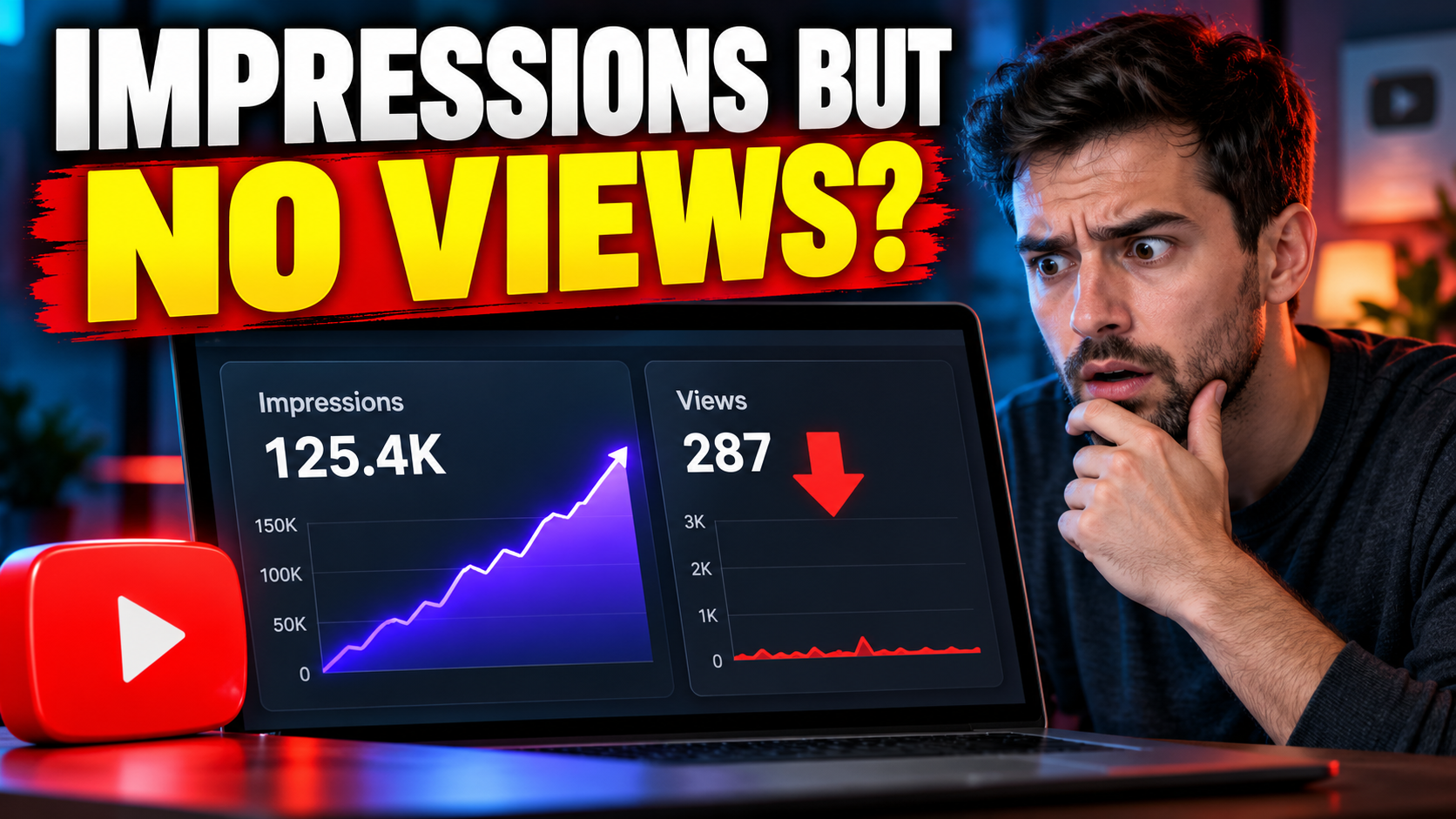
Why YouTube Videos Get Impressions but No Views: Causes and Fixes
Your YouTube video is getting impressions, but the view count barely moves. You may have spent hours editing, writing a title, and designing a thumbnail, only to see little engagement after publishing.
This does not automatically mean your video is bad or that YouTube has stopped recommending your channel. The problem could be your title, thumbnail, topic, audience targeting, or the gap between what viewers expect and what your video actually delivers.
In this guide, you will learn how to diagnose low views using YouTube Analytics and identify practical ways to improve your video's performance.
What Does It Mean When a YouTube Video Gets Impressions but No Views?
A YouTube impression occurs when your video thumbnail is shown to a viewer in an eligible location on YouTube, such as the homepage, search results, or certain recommendation surfaces.
A view is a separate metric. Someone may see your thumbnail and title without deciding to click.
When impressions increase but views remain low, start by examining how clearly your title communicates the video's value, whether the thumbnail attracts the right audience, and whether the topic matches viewers' interests.
Keep in mind that not every YouTube view comes from a registered thumbnail impression. Views from some external sources and other surfaces may not be included in the impressions metric.
1. Your Thumbnail Does Not Communicate the Value of the Video
Your thumbnail helps viewers decide whether your video deserves their attention. If it is cluttered, difficult to understand, or visually unrelated to the topic, people may scroll past it.
How to Improve Your YouTube Thumbnail
Focus on one clear visual idea instead of too many competing elements.
Use short, readable text that remains clear on mobile screens.
Create enough contrast between the background and the main subject.
Make the benefit or central question easy to understand.
Ensure the thumbnail accurately represents the video's content.
For example, instead of using a generic thumbnail that says "YouTube Tips," try a more specific message such as "Why Your Videos Get No Views."
The goal is not simply to create an attractive image. It is to help the right viewer understand why the video is relevant to them.
2. Your Video Title Does Not Match Search Intent
A video can appear in search results without attracting clicks if its title is too vague, overly broad, or disconnected from the question viewers want answered.
A strong title should communicate the topic clearly and give viewers a realistic reason to watch.
Before publishing, ask yourself:
Does the title address a specific question or problem?
Can viewers understand the video's main benefit immediately?
Does the title accurately describe what the video delivers?
Is it distinct from competing videos covering the same subject?
For example:
Generic title: YouTube Tips for Beginners
More specific title: How to Improve Your YouTube Click-Through Rate
The second title targets a clearer problem and sets a more specific expectation. However, it will only work well if the video provides useful advice on that subject.
Avoid misleading promises, excessive keyword repetition, and titles that exaggerate the results viewers can expect.
3. Your Topic Is Not Reaching the Right Audience
Not every impression represents a strong opportunity for a view. Your video may be shown to people who are not interested in the subject, or the topic may be too broad to communicate a clear benefit.
This can happen when creators publish unrelated videos without considering the audience each video is intended to serve.
How to Choose More Relevant Topics
Review your best-performing videos and identify common subjects, questions, and audience interests.
Explore YouTube search suggestions to discover specific questions people may be asking.
Study competing videos to find useful angles that have not been explained clearly.
Build each video around one main question or outcome.
Check whether the topic fits the audience you want to attract.
For example, a gaming channel may get more relevant viewers from a video explaining how to fix a specific game error than from a broad video about gaming trends.
This does not guarantee more views, but it gives the video a clearer purpose and makes it easier to create content for a defined audience.
4. Your YouTube Click-Through Rate Is Low
Impressions click-through rate (CTR) measures how often viewers watch a video after seeing its thumbnail in eligible YouTube impression placements.
A simplified calculation is:
CTR = Views generated from impressions ÷ Impressions × 100
For example, if a video receives 10,000 eligible impressions and has a 3% CTR, that represents approximately 300 views associated with those impressions. It does not necessarily represent the video's total views.
There is no single CTR that guarantees success. Results vary depending on the traffic source, audience, topic, channel size, and how widely the video is being recommended.
How to Interpret Your CTR
High impressions and low CTR
Review your title, thumbnail, and audience relevance. Your video is being shown, but viewers may not see a compelling reason to click.
Low impressions and relatively strong CTR
Investigate the topic's demand, your traffic sources, and whether the video is reaching new audiences. A small number of impressions can make CTR fluctuate considerably.
Reasonable CTR but limited overall growth
Look beyond clicks. Review watch time, audience retention, and traffic sources to understand what happens after viewers open the video.
Compare similar videos on your own channel rather than judging every upload against one universal benchmark.
5. Viewers Leave Shortly After Clicking
A strong title and thumbnail can attract clicks, but they cannot compensate for an introduction that delays the promised value.
If viewers expect a tutorial and spend the first minute watching an unrelated introduction, they may leave before reaching the useful part.
Practical Ways to Improve Audience Retention
Introduce the main problem or benefit early.
Remove long introductions that do not help viewers.
Explain what viewers will learn or see.
Use demonstrations, examples, or relevant footage to support your explanation.
Remove repetition and sections that do not advance the main idea.
Open YouTube Studio and navigate to Analytics to review the audience retention report when available. Look for significant declines and examine what happens at those moments.
A drop does not always mean the content is poor. It can also reflect a change in topic, viewer expectations, or the normal behavior of your audience. Use the graph alongside the video itself to understand the likely cause.
6. Your Channel Lacks a Clear Content Strategy
Publishing unrelated videos can make it harder to build a consistent audience that returns for more content.
YouTube does not require every channel to cover only one subject. However, a recognizable content direction can help viewers understand what your channel offers and whether they want to subscribe.
Build Related Content Groups
If your channel focuses on content creation, for example, organize videos around related themes:
Finding video ideas and researching topics.
Writing titles and designing thumbnails.
Improving editing, pacing, and audience retention.
Using YouTube Analytics to measure performance.
Turning successful topics into follow-up videos.
Connect related videos through playlists, end screens, and relevant links in descriptions where appropriate.
The goal is to help viewers find the next useful video, not simply to increase the number of uploads.
7. You Are Not Reviewing Your Traffic Sources
The reason a video struggles can differ depending on where viewers encounter it.
Videos that target search queries need to answer a relevant question clearly. Videos that rely on the homepage or suggested videos need to communicate their value to viewers who may not be actively searching for the topic.
In YouTube Studio, open the video's Analytics and review the traffic sources available in the report.
Pay attention to:
YouTube Search.
Suggested videos.
Browse features, including eligible homepage traffic.
External sources.
Channel pages and other sources shown in your report.
If YouTube Search contributes little traffic, review the topic and how well the video answers the intended question.
If the video receives impressions from recommendations but attracts few clicks, reassess the title, thumbnail, and audience relevance.
Use the retention report to understand whether people who do click continue watching. This helps you distinguish a packaging problem from a content problem.
A Practical 7-Day Plan to Improve a Low-View YouTube Video
Use this plan to investigate a video's performance without making several changes at once.
Day 1: Record Your Baseline
Record impressions, CTR, views, watch time, audience retention, and traffic sources where available. Keep the data so you can compare performance later.
Day 2: Review the Title and Thumbnail
Check whether they communicate one clear idea and accurately represent the video. Identify what might prevent your intended audience from clicking.
Day 3: Analyze Audience Retention
Review the retention graph and inspect sections where viewer interest appears to decline. Pay particular attention to the introduction and whether the video delivers its promised value.
Day 4: Reassess the Topic
Compare the video with similar uploads on your channel. Check whether the subject is relevant to your intended audience and answers a specific question.
Day 5: Make One Meaningful Change
If the evidence points to a packaging issue, consider improving the title or thumbnail. Avoid changing everything simultaneously, because that makes it harder to understand which change may have helped.
Day 6: Review Traffic Sources
Identify where the video receives impressions and views. Use the results to decide whether to improve search relevance, audience targeting, or the presentation of the video.
Day 7: Compare the Results
Compare the new data with your baseline, accounting for differences in traffic sources and sample size.
Do not treat one day of results as conclusive evidence. Some videos need more time and enough data before a useful pattern becomes clear.
This plan is a diagnostic framework, not a guarantee that views will increase within seven days.
Can Buying YouTube Views Fix Low Video Views?
Buying views is not a reliable substitute for understanding why viewers are not choosing your video.
A higher displayed view count does not necessarily mean your content is attracting a relevant audience, improving retention, or building a channel that people want to revisit.
YouTube prohibits artificial engagement intended to inflate metrics, including artificially increasing views, subscribers, or watch time. Invalid engagement may be removed and can affect monetization eligibility or lead to other channel enforcement actions.
If your goal is to qualify for the YouTube Partner Program, focus on eligible public watch hours and valid public Shorts views according to the applicable requirements. Not every view or hour recorded in Analytics necessarily counts toward monetization eligibility.
A more sustainable approach is to improve your content, strengthen your titles and thumbnails, understand your analytics, and promote your videos through methods that comply with YouTube's policies.
Frequently Asked Questions
Why does my YouTube video appear in search but get no views?
The title may not clearly answer the searcher's question, the thumbnail may not communicate the video's value, or the topic may not match the viewer's intent. Check impressions, CTR, and traffic sources to identify the most likely issue.
Will changing my YouTube title increase views?
It may help if the original title is unclear, too broad, or poorly aligned with the video's content. However, a title change does not guarantee more views. Make a specific, accurate improvement and monitor the results over time.
What is a good CTR for YouTube videos?
There is no universal ideal CTR. It varies by audience, traffic source, topic, and how widely a video is distributed. Compare similar videos on your channel and consider CTR alongside watch time and audience retention.
Does low CTR mean YouTube has stopped recommending my video?
Not necessarily. Review the impressions report and traffic sources to see whether the video is still appearing in search, browse features, or suggested videos. Distribution can change as YouTube evaluates how viewers respond to content.
Are views enough to measure a video's success?
No. Views are only one metric. Watch time, audience retention, subscribers gained, traffic sources, and whether the video achieves its intended goal can all provide useful context.
Final Thoughts
Getting YouTube impressions without views does not automatically mean your video has failed. It means you need to investigate how viewers respond to the topic, title, thumbnail, and content.
Start with YouTube Analytics, identify the most likely bottleneck, make a focused improvement, and compare the results over time.
The key principle is simple: do not focus only on increasing the view count. Understand why the right viewers are not choosing your video, then improve the part of the experience that the data points to.